I've been doing a lot of reflecting lately on the power of social learning - the learning that happens with and through other people.
Since founding Crackin' LnD (Down Under) in June 2024, I've had a front-row seat to the power of social learning. And along the way, I've learnt a few lessons of my own.
When we started, I thought I knew what we were building. A place for L&D people across Aotearoa, Australia and the Pacific to connect, network and learn. Good speakers. A calendar of events. A few virtual meet-ups here and there.
It was a reasonable starting point. Probably the one most of us would choose. And it turned out to be only half right.
Let's head to the kitchen for a moment.
When I started, I did what most community builders do - I planned a set menu. Meet-ups and sessions in order. Everything prepared in advance and served on time.
What I've learnt is that a thriving community is much more like a potluck dinner. Everyone brings a plate. Nobody quite knows what will turn up on the table, and the best dish is rarely the one you planned. My job isn't to cook - it's to set the table, welcome people in, and notice who's still standing by the door.
That shift - from set menu to potluck - sits at the heart of what Crackin' LnD has taught me. You can plan all the right things and hope people turn up. Or you can flip the curriculum, and work with the community to discover what they actually want to gather around.
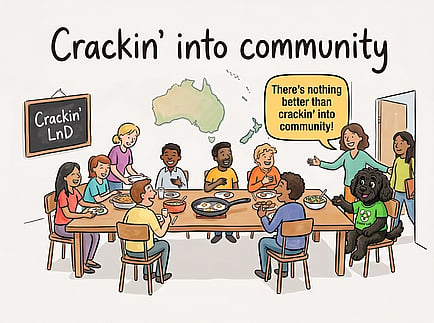
What Crackin' LnD Has Taught Me
You know, it's taught me lots, but a few lessons keep surfacing. Are there more? Oh gosh, yes! But these are the ones that are top of mind - the ones I keep cycling back to.
Connected to isn't connected in
Numbers can be seductive. Members joined. Registrations up. Followers growing. It's tempting to read that as the measure of a great community. It's exciting to see it grow, right?
But being connected to a community and being connected in one are two very different things. Being connected to a community is membership. Being connected in a community is participation, contribution, agency - the sense that this is our place, a place where we belong and where we matter.
Most people in any community watch and listen more than they post. That's okay - it's a legitimate way to learn. But a community only comes alive when enough people feel safe and encouraged to step in, not just sign up.
So the question I ask now isn't "how many?" It's "how many people have shaped what we're about and what we do?"
Whakawhanaungatanga before content
In te ao Māori, it's not about jumping straight to the business. It starts with who we are, where we're from, and how we're connected. Whakawhanaungatanga - the building of relationships - comes first. Something those of us shaped by Western ways of working have a lot to learn from.
So for me this isn't a nice cultural add-on. It's structural. People don't share half-formed ideas, failures, or "I have no idea what I'm doing" moments with strangers. They share them with people who've made room for them. People they have a relationship with and trust.
You can't do it on your own
In the early days, Crackin' LnD was very much me. Planning the sessions, writing the posts, sending the reminders, hosting, following up.
It worked - for a while. But a community that depends on one person isn't really a community. It's a one-person show with an audience. And one-person shows have a habit of running out of steam.
It wasn't long before I realised we needed a small group to drive the community - hence our tiny but mighty core team.
Hey, social learning needs social leadership, right?
Our core team isn't just extra hands. It's extra perspectives, extra networks, extra courage. Each person brings people with them who might never have found us otherwise. Each person notices things I miss. And each person holds me to account when I drift from what we're about.
It also meant practising what I preach. Letting go of doing it my way - oooh now that can be hard. Sharing the decisions, not just the jobs.
The stage, or the space?
This is the one that can be most challenging. As a learning designer and community leader, I like a plan. I like knowing where things are heading. And if I'm honest, I like being useful.
But I've learnt that the more I hold on, the less room there is for anyone else. Every session I over-plan, every gap I rush to fill, every question I answer first - it quietly tells people this is my space, not our space.
Some of the richest learning in Crackin' LnD has happened when I stepped back. Sometimes that's in the middle of a session. Sometimes it's members running with ideas for sessions they want to organise themselves. It's early days for that, but the more it happens, the more excited I get about us maturing into a strong learning community.
I recently had a five-week holiday overseas, and as a core team we had to really think through what would happen while I was away. Well, guess what? With a little bit of planning it all carried on just fine, and it reinforced just how important it is to leave space for others to flourish.
That's what I call Flipping the Curriculum. The leader's job shifts from delivering the learning to designing the conditions for it - clear invitations, low-stakes ways in, shared ownership, and comfort with silence. Then getting out of the way.
For leaders, that's the real shift - from being the expert at the front to being the host who makes room.
And watching someone who joined to listen become the person running something in the community? That journey from the edge to the centre is, for me, the clearest sign a community is working.
Have you ever noticed what happens in a room when the leader steps back?
What Learning in Community Gives Others
So that's what it's taught me. But what does learning in community actually give the people in it?
Belonging - especially for teams of one
There are a number of L&D practitioners in our corner of the world who work solo or in tiny teams. What we hear is that community gives them the colleagues they don't have at work. People who get it. People to explore ideas with. People to connect and hang out with.
Somewhere to think out loud
Courses give answers. Communities give you somewhere to work out the question.
When you put your thinking into words for someone else, you discover what you actually think. Peer learning does this naturally. Every time someone answers a question in our Slack or shares in the Monday Mull, they're learning as much as the person who asked.
Relevance you don't have to manufacture
I've come to think a lot of L&D overwhelm isn't really about volume. It's about relevance. In community, the content comes from real problems people are wrestling with this week. Nobody has to make it relevant. It already is.
And being free matters here. It means the only currency is contribution.
Not the Strength of One
Building Crackin' LnD hasn't made me an expert in community. If anything, it's made me more of a learner.
It's taught me that the curriculum was never the calendar. The curriculum is the community - the people, the questions, the relationships, the generosity.
As the whakataukī reminds us:
"Ehara taku toa i te toa takitahi, engari he toa takitini." My strength is not that of one alone, but that of many.
So let me leave you with a couple of questions:
Where are you connected to - and where are you connected in? Who's at your table - and who's still standing by the door?
If you're an L&D practitioner in Aotearoa, Australia or the Pacific looking for your table, there's always a seat at Crackin' LnD. Bring a plate. 🍳
Ngā mihi, Darryn
NB: If you are an LnD professional in Australia, New Zealand or the Pacific Islands you can join Crackin' LnD (Down Under) at https://www.linkedin.com/groups/14462967/
